


Why We Built SOLEV — The Problem with eBike Charging Infrastructure

Company Story · SOLEV Pty Ltd · Sydney, Australia
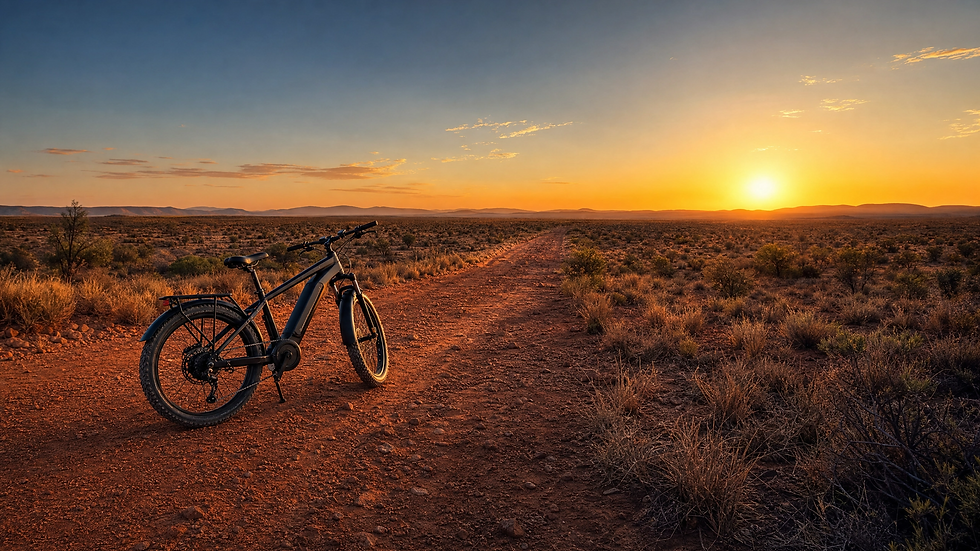
Every great product starts with a problem that nobody has solved properly yet.
For SOLEV, that problem was simple to describe and surprisingly hard to solve:
How do you charge an eBike when there's no power point?
The Gap Nobody Was Filling
The electric bike market has grown explosively over the past decade. Millions of Australians now ride eBikes — commuters, retirees, adventurers, farmers, hunters, prospectors. The technology has improved dramatically. Batteries last longer. Motors are quieter. Bikes are lighter.
But one fundamental problem remained completely unsolved.
The moment you took your eBike somewhere remote — a free campsite, a bush trail, a prospecting site in outback WA — you were entirely dependent on finding a power point. And in most of the places Australians actually want to ride, power points simply don't exist.
Generators were the only answer. Heavy. Noisy. Expensive to run. The kind of equipment that belongs in a construction site, not strapped to a bikepacking kit or lugged into the outback.
There had to be a better way.
The Insight — In-Situ Energy Generation
The breakthrough wasn't a new battery technology or a faster charger. It was a shift in philosophy.

Instead of asking "where do I find power to charge my bike?" — the right question was:
"What if the bike charged itself, exactly where it was parked?"
This is what we call in-situ energy generation. Power created on the spot, by the sun, at the exact location where the bike is sitting. No infrastructure. No extension cords. No grid dependency.
The sun shines everywhere in Australia. In fact, Australia receives more solar radiation per square metre than any other continent on Earth. Every time an eBike is parked outdoors, there's an opportunity to generate free, clean, silent power from the sun above it.
The question was how to capture it practically.
The Engineering Challenge
Solar panels capable of generating meaningful power are large. A 175–235W array — enough to charge an eBike in a few hours — takes up significant space when deployed.
That's fine if you're a dedicated solar eBike expedition rider, willing to permanently mount panels to your bike. But for the vast majority of eBike owners — people who want to charge their existing bike, not rebuild it — permanent mounted panels are impractical, expensive and aesthetically unacceptable.
The solution had to be portable. Compact enough to carry. Fast enough to deploy. And compatible with every eBike brand already on the market.
That led to the invention at the heart of SOLEV: a patent-pending bi-directional accordion folding mechanism that compresses a large solar panel array into a package the size of a shoebox — in under 30 seconds.
The Folding Mechanism Changes Everything
The bi-directional accordion fold is genuinely novel. Unlike conventional single-direction folding solar panels, our mechanism folds simultaneously in two directions — allowing a panel array of 175–235W to compress into a 21×29cm stack.
Pick it up with one hand. Carry it like a lunchbox. Unfold it in under 30 seconds. Drape it over your bike and let it charge.

When you're done, fold it back up. It fits inside its own carry case — with room inside for your eBike charger.
This mechanism is the foundation of everything SOLEV builds. Not just the Solar eBike Cover — but every product in our roadmap.
The Compatibility Decision — Why AC Output
One of the most important engineering decisions we made was choosing AC output over DC charging.
Direct DC charging is technically more efficient — no conversion losses. But it requires matching the exact voltage and connector specifications of each eBike battery and BMS (Battery Management System). With dozens of different brands, proprietary connectors and CAN-bus protocols, building a DC system that works with every eBike was either impossibly complex or impossibly expensive.
The solution was elegant: power the bike's own charger.
Every eBike comes with a charger. Every charger accepts standard AC input. By delivering AC output, the Solar eBike Cover works with every eBike brand on the planet — Bosch, Shimano, Bafang, Yamaha and hundreds more — through the charger the rider already owns.
No adaptors. No modifications. Universal compatibility, forever.
And as a bonus — switching to AC output increased our panel output from 90–120W in Trial 1 to 175–235W in Trial 2. A smarter engineering decision that made the product better in every way.
Trial 1 — The Concept Proved Itself

Theory is one thing. Real-world performance in the Australian bush is another.
In 2024, we placed three Solar eBike Cover units with three Australian riders — a hunter from Rocky Camp SA, an eTrike rider from Seaford SA, and a gold prospector from The Vines WA.
Their mission: ride, charge and report back honestly.
Robert Hunter, our SA hunter, had his unit working on the first day: "Plugged the charger in before opening the panels and it's working perfectly."
Ken Lew, our Seaford eTrike rider, discovered something we hadn't even thought to market: "The panels protect the eBike from the sun. That's a big plus."
And Steven Palmer, our WA gold prospector, put it through ten days of off-road riding through sand dunes and coastal scrub at Starvation Bay — charging two bikes completely off-grid — and came back with the line that said everything:
"It will save me taking the generator."
That was the validation we needed.
Trial 2 — The Improved Version
Based on Trial 1 feedback, we developed the improved Trial 2 version:
Output increased to 175–235W — from 90–120W
Switched to AC output — universal compatibility with every brand
Refined the folding mechanism based on rider feedback
Improved the carry case design
Trial 2 is currently underway with four Australian riders across different states, use cases and vehicle types. The results will shape the production version.
Why Australia First
Australia is the ideal launch market for SOLEV — and not just because we're Australian.
Australia has the highest solar irradiance of any continent. The combination of vast distances, limited charging infrastructure, and abundant sunshine creates perfect conditions for solar eBike charging.

The riders who need this product most — outback adventurers, gold prospectors, hunters, free campers, grey nomads — are disproportionately Australian. They ride in exactly the conditions where power points don't exist and generators are the only alternative.
We're building for them first. Then the world.
What Comes Next
The Solar eBike Cover is our first product. The bi-directional folding mechanism is our platform.

The same mechanism that folds a solar panel array into a shoebox can fold a car cover, a boat cover, an awning, a shade structure. Any flat panel system that needs to compress from large to small.
SOLEV's mission is to bring in-situ solar energy generation to every vehicle, every adventure, every place the sun shines.
We're just getting started.
Follow the Journey
Trial 2 is underway. The production run is being planned. A global launch is coming.
If you ride an eBike, eTrike, eCargo, eMoped or electric motorcycle in Australia — and you've ever been frustrated by the lack of charging infrastructure — we built SOLEV for you.
👉 Product details: solarebikecover.com 👉 Apply for Trial 2: solev.com.au 👉 Get in touch: info@solev.co
SOLEV Pty Ltd · Sydney, Australia · 🇦🇺 Australian owned & designed As seen at Eurobike 2025 · Frankfurt
Comments